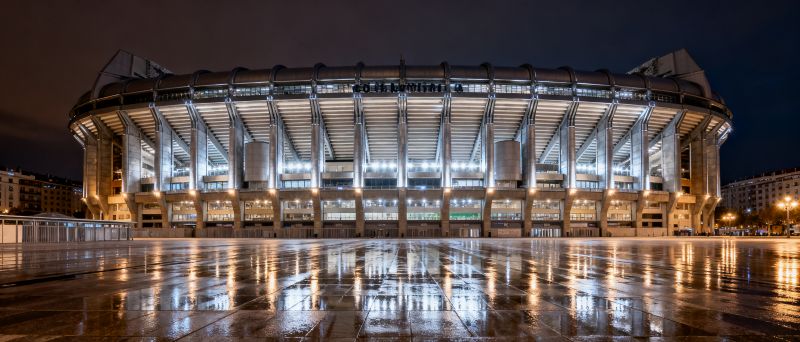
he first thing you notice inside the Santiago Bernabéu isn't the grass or the seats. It's the roof. A steel ring closes overhead like a lid, and the noise has nowhere to go but down. That single architectural decision, completed in 2024 after years of stop-start construction, did more for the stadium's reputation than any signing. People talk about the Shining Bernabéu the way they talk about a great concert hall — as a machine for producing feeling。not just a place to watch a match.What makes the Shining Bernabéu work is less about the exterior skin and more about controlled contrast. The renovated façade wraps the old concrete frame in polished steel slats, and at night, thousands of LEDs turn the surface into a slow-moving canvas. For visitors, the effect is subtle: a wall that shifts from near-black to warm silver and then to something close to white as you walk toward the gates. On the east side, where the plaza opens up, the stadium behaves like a mirror during the day and a lantern after dark. That duality is deliberate. Real Madrid's renovation brief。budgeted at over €1 billion, demanded a building that could host a football match on Saturday and a concert on Sunday without either feeling like an afterthought, and the lighting scheme was designed around that double life.
Atmosphere is harder to engineer than architecture. Anyone who watched the 2024–25 season home matches noticed a shift in the crowd's behavior. The retractable pitch, stored in a climate-controlled underground chamber, means the surface is always pristine — and players respond to that consistency. Luka Modrić, in one of his final home appearances, described the pitch as feeling new every week. Small detail, but it matters. The Shining Bernabéu's acoustics。amplified by the closed roof and the steepened stands, have turned ordinary league fixtures into something louder than they used to be. Opponents feel it. A visiting coach from La Liga, speaking after a 3–0 defeat, admitted the noise during the second half made communication on the touchline impossible.Not everything has landed cleanly. The €1.2 billion project ran into noise complaints from residents on Padre Damián, and the club suspended concert bookings in 2024 pending acoustic fixes. Scaffolding lingered on the Castellana side longer than anyone wanted. The retail megastore and the new Bernabéu Market feel slick。but the concourses on the upper tiers still get jammed before kickoff. You notice these things because the rest of the building sets such a high bar. When a renovation gets 90 percent right, the remaining 10 percent stands out more, not less.Still, the Shining Bernabéu has done what few stadium renovations manage: it changed how a city talks about a building without changing what happens on the pitch inside it. Madrid residents now use the stadium as a landmark in directions — "turn left at the shiny one" — which tells you something about how thoroughly it has entered local language. The old Bernabéu was famous for history. The new one is famous for presence. That is a different kind of achievement, and a harder one to sustain.